
Description: A participant in CHOP's Food Pharmacy Program receives their box of fresh produce at their doorstep. Photo credit: Food Connect
On a typical weekday at Children’s Hospital of Philadelphia (CHOP), the Food Pharmacy Program team is busy at work.
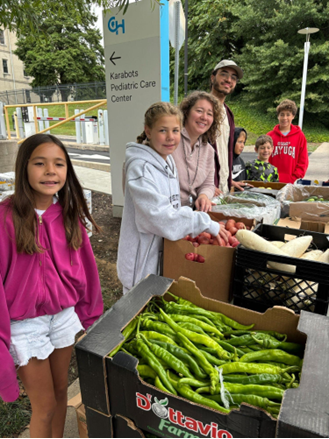
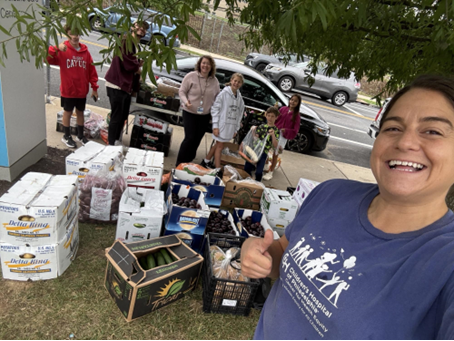
Outside of the Nicholas and Athena Karabots Pediatric Primary Care Center, a produce market is set up for the day. Sapphire Johnson, the Food Access Coordinator, greets families as they arrive, helping them navigate tables of fresh fruits and vegetables available at no cost. The market is open to all, offering a consistent, weekly opportunity for families to access fresh food.
Elsewhere, Stephanie Soto, the Resource Navigator, is reviewing a list of households enrolled in home-delivery, noting any updates before the next order is placed. Some families will receive fresh produce boxes, while others are scheduled for more specialized pantry boxes. The order is submitted on Tuesday for Friday delivery, and within a few hours, Sapphire receives confirmation that more than 200 boxes are in motion.
Behind each step is a network of partners working together to make it possible. Sharing Excess redistributes surplus food from businesses to supply the markets. Common Market aggregates products from local farms and prepares boxes for the home-delivery program. Food Connect coordinates the delivery of food boxes directly to families’ homes.
Together, they make a complex system function in a way that feels coordinated and reliable. For the CHOP team, that coordination is essential to reaching the families they aim to support.
The Food Pharmacy program is designed to support families navigating both food insecurity and medically complex conditions. Screening happens at multiple points within the care process, including a set of standard questions, anchored by two key questions about whether families have worried about running out of food or experienced food not lasting through the month.
From there, families can be referred into the program and enrolled for six, nine, or twelve months, receiving regular food support alongside their clinical care.
The program began in 2018, when Dr. Saba Kahn identified a gap between what families were being advised to eat and what they were realistically able to access. Even when nutrition was part of a care plan, it was not always feasible for families to obtain the recommended foods.
In 2020, during the early stages of the COVID-19 pandemic, the program expanded quickly to include home delivery. What began as a response to immediate constraints revealed something more lasting. Even as in-person services resumed, many families continued to face barriers that made consistent access to nourishing food difficult.
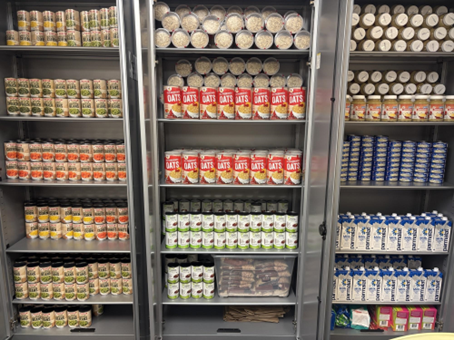
Initially operating more like a traditional pantry, focused on shelf-stable and dry goods, the program has evolved to prioritize fresh food, reflecting both the needs of families and the role nutrition plays in long-term health.
For many families, the challenge is not only about whether food is available. It is about how to access it within the realities of daily life.
Some families are managing chronic illnesses while caring for children with complex needs. Others are working irregular hours or do not have reliable transportation. A trip to pick up food can require coordinating multiple schedules or choosing between competing priorities.
As the team describes it, one of the hesitations families often have when they’re invited to participate in the program is around logistics. Where would they need to go to pick up the food? How would they get there, and would it fit into an already full schedule?
Home delivery addresses those barriers directly. It allows families to receive food consistently without adding additional strain to their routines.
“It might just seem like a box of produce, but to the families it’s so much more,” shared Stephanie. “They’re making smoothies, they’re eating salads. Families are telling us they’re able to try new foods and expand their diets in ways they couldn’t before.”
She also described hearing from new moms who are breastfeeding and relying on the boxes as a consistent source of nourishment, especially in the early months when leaving home can be difficult.
That same feedback is reflected in what providers are hearing in clinical settings. Families are more willing to incorporate fresh foods into their routines when those foods are accessible, and that shift is shaping how care plans are experienced at home.
Because the boxes are built from what is available through local sourcing, they are not always uniform. Families receive a range of produce, dairy, and other staples that vary from month to month, depending on what is in season. From the team’s perspective, that variability has not been a barrier. Food Pharmacy Manager Abbe Stern noted that when participants receive something unfamiliar, many will simply look it up and find ways to incorporate it into their meals.
Today, the Food Pharmacy program reaches hundreds of families each week and has served more than 800 families over the past three years. That level of reach is closely tied to the program’s operational model and the partners who support it.
As Abbe explains, "Families are receiving boxes of food at their homes, solely because of this partnership. We’re a team of three—we couldn’t manage the driving, the coordination, the communication. It wouldn’t be sustainable.”
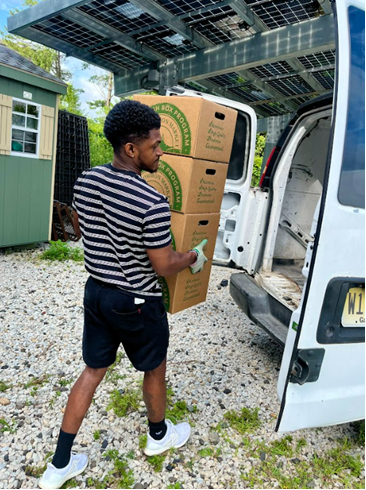
Food Connect’s role includes coordinating delivery routes, managing real-time communication with families, and ensuring that food boxes arrive within expected timeframes. If a family is not home at the time of delivery, they receive a message, allowing them to respond or make adjustments. An approach that helps reduce missed deliveries and makes it easier for families to participate in the program.
This level of logistical support allows the team to focus on clinical care and program coordination, while partners manage the demands of delivery at scale.
Stephanie also pointed to the ease of communication as a key part of the partnership. She works closely with Stacey, a dispatcher at Food Connect, to coordinate deliveries and adjust plans when needed, helping ensure that deliveries remain responsive to families’ schedules and consistent in how the food is received.
Abbe shared that the success of Food Connect’s home delivery services has made it possible to expand the program and demonstrate its impact, opening the door to new grants and continued growth.
The program’s value to participants is clear to the Food Pharmacy team. As families near the end of their enrollment period, many ask to be re-enrolled, pointing to how valuable consistent food access is to their day-to-day lives.
With the program continuing to grow, the team is beginning to explore how its impact can be measured.
“We’re starting to think more about what we can track over time,” Abbe shared. “Are families more likely to come to their appointments? Are satisfaction scores changing? Are providers seeing different outcomes across clinics?”
These questions reflect how the team is thinking about the program’s future, both in terms of its reach and understanding its long-term impact.
Home delivery is already shaping what is possible. It allows more families to participate and stay engaged in the program, even when other barriers remain, and gives the team at CHOP more time to focus on providing high-quality, holistic care.
This story was developed with input and permission from Abbe Stern, Stephanie Soto and Sapphire Johnson of CHOP’s Food Pharmacy program.
5/6/2026


Get the latest updates on food rescue efforts, community impact, and ways to get involved


.webp)

