

Back to News
Food Connect came to the Twin Cities with help from the GreenLight Fund and helps to supply fresh produce for clients of the Department of Indian Work’s food pantry. Uche Iroegbu in Creative Collaboration with The Food Group.
The call couldn’t have come at a better time. Theresa Halvorson-Lee oversees a food pantry serving Native Americans in the Twin Cities. Her volunteers were getting worn down by time-consuming “food rescue” — driving each week to pick up expiring or damaged products.
Early last year, a new charity in town — Food Connect — offered to help. The Philadelphia-based group specializes in last-mile logistics, working with existing hunger-relief organizations to collect surplus food from grocery stores, farms, food banks, and restaurants and deliver it where it’s needed.
With a Food Connect driver now making weekly pickups, volunteers at the Department of Indian Work, a division of a larger Twin Cities charity, could shift their focus to what they valued most: working directly with people who rely on the pantry.
“The help from Food Connect fell into our laps — it was a breath of fresh air,” says Halvorson-Lee, who is also the department’s director. “Our volunteers were just expressing their discontent in continuing to do this.”
Halvorson-Lee didn’t spend much time dwelling on how Food Connect had arrived in the Twin Cities or why.
The answer to those questions is the work of the GreenLight Fund, which helps cities identify urgent needs and finds outside charities that can help. GreenLight is one of the most successful attempts to resolve a persistent tension in modern philanthropy: between social entrepreneurs and philanthropists who want to expand anti-poverty efforts and low-income communities that are rightfully wary of outsiders imposing solutions.
Its approach — adding just one nonprofit per year in each city after an intensive, community-driven vetting process — has made it one of the clearest examples of how philanthropy can expand proven ideas without overwhelming local organizations. Nationwide, GreenLight sites have helped launch 71 charitable programs, and those programs now reach more than 1.3 million individuals and families per year.
GreenLight raised $30 million for its latest national fund last year — twice as much as its previous fund. Its broad list of financial supporters include Bain Capital, Bank of America, the NFL, and the Nathan Cummings Foundation. MacKenzie Scott has given the organization two gifts totaling $28 million since 2021. And the core principles of GreenLight’s work — such as emphasizing local needs over a given charity’s capabilities and insisting that every charity it sponsors has a solid financial base from earned revenue or government grants or contracts — are having a spillover effect. Many of the individual donors who support GreenLight also adopt some of its methods in their donations to other projects.
But the GreenLight model also raises persistent questions, such as whether importing nonprofits to a city risks sidelining homegrown groups and their fundraising. What’s more, some wonder whether GreenLight’s emphasis on financial stability reflects strategic restraint or leaves potentially effective groups out of the running.
GreenLight was founded in Boston in 2004, near the height of the “venture philanthropy” era, when donors sought to expand promising nonprofits quickly across the country — often with mixed results. The period was an important part of the evolution of the nonprofit sector, says Jeffrey Bradach, a partner at the Bridgespan Group who co-founded the firm in 2000. But outsiders often acted as if they had better insight into what communities needed than the people who lived there, he admits.
“Every community isn’t waiting with open arms for whatever you think is the best idea,” Bradach says. “I would say we all had a little hubris.”
GreenLight took a different approach — and in Bradach’s view, came up with a better mousetrap. Co-founders John Simon and Margaret Hall spent eight years refining the model in Boston before expanding it to other cities. GreenLight has grown at a deliberately measured pace ever since. It starts its work in each city with a local committee of experts to get community buy-in — the “green light” to bring a new charity to town. Simon, who made a fortune with two venture-capital firms, and his wife, Susan, have contributed close to $20 million to GreenLight, and he says that amount will “grow substantially in the coming years.”
The GreenLight approach is simple and highly structured: Bring in one new charity per year in each city where it works. First, GreenLight raises enough money locally — typically $5 million to $6 million — to support the program for five years, including paying for a full-time executive director. Then the annual rhythm begins. GreenLight and a volunteer committee of local experts from government, philanthropy, business, education, and nonprofits spend months identifying the city’s biggest need or problem. GreenLight then goes out to find the best charity in the country that can tackle that issue. GreenLight offers local support and introductions and a multiyear grant averaging $600,000 to $800,000 if the charity agrees to begin working in the city.
“We don’t push,” says Simon, who remains GreenLight’s highly active board chair. “We pull organizations in.”
GreenLight’s Twin Cities site opened in 2020, a chaotic year that included the worst of the pandemic and the racial uprising following the murder of George Floyd by a Minneapolis police officer.
Even as the city began to recover, some measures of well-being worsened. The number of food-pantry visits statewide hit a record for a third consecutive year in 2024. The GreenLight site’s Selection Advisory Committee identified hunger as the city’s most pressing problem that year.
Food Connect stood out as a strong candidate to address that problem: It had already expanded to two cities with GreenLight’s help. Food Connect is one of about 2,000 charities in GreenLight’s database of vetted organizations — groups that have demonstrated results, a proven ability to grow bigger, and some form of sustainable revenue beyond philanthropy.
Simone Hardeman-Jones, the executive director of GreenLight Fund Twin Cities, traveled to another GreenLight site in Kansas City to see Food Connect in action. Then Food Connect leaders came to Minneapolis to make their pitch to the Selection Advisory Committee. Ultimately, the GreenLight site tapped Food Connect as its chosen charity for 2024, providing a $600,000 multiyear grant and helping introduce Food Connect to local leaders and donors.
Since its founding in Philadelphia in 2014, Food Connect has now spread to four more cities, each time with GreenLight’s help.
For Megha Kulshreshtha, Food Connect’s founder and CEO, expanding outside Philadelphia was always part of the dream. But doing it alone would have been filled with risks, she says.
“Who needs what we offer? How do we approach it? Do we have anchor partners?” Kulshreshtha says. “We don’t always have the capacity to decipher all of that. So to have somebody that’s already identified a community, already lined up funding, and can do warm handoffs — that makes it an easy yes for us to be responsive to that community.”
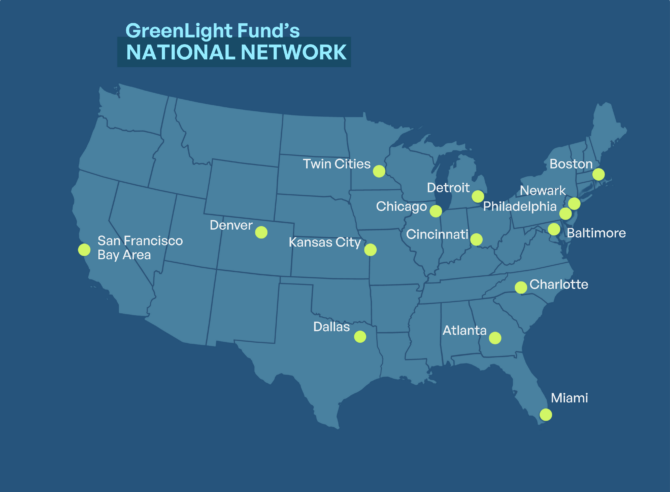
GreenLight’s national expansion is moving at about the same pace as its local sites — the charity is adding roughly one more city per year. Dallas opened in late 2025, and Nashville and the District of Columbia are up next.
The Simons were generous supporters of charities throughout Boston in the early 2000s. But when they became familiar with the work of Harvard economist Raj Chetty — and the long odds that children in certain cities have of escaping poverty — the couple began to ask: “Are we doing enough?”
Simon has been all in on GreenLight ever since. Ultimately, he sees the charity becoming part of the national nonprofit firmament, not unlike United Ways and community foundations.
Simon often frames GreenLight’s impact in terms familiar to for-profit investors: compounding returns.
One common strategy is to use philanthropic dollars to leverage public funding.
GreenLight Fund Boston made a grant worth $600,000 in 2008 to bring in Youth Villages LifeSet, which helps older kids transition from foster care to adulthood. Simon goes into a math-laced riff to illustrate the return GreenLight is getting from its modest investment. The state is now spending $2,000 to $3,000 on each child LifeSet works with. Two thousand kids a year equals $5 million a year — and potentially $100 million of government spending over 20 years, Simon says.
“In a 20-year period, if we reach a couple thousand kids on average, we could change 40,000 lives,” Simon says. “If we hadn’t done GreenLight, it wouldn’t have happened.”
His infectious enthusiasm for GreenLight, coupled with his deep Rolodex from decades in venture capital, wins Simon entrée to meetings with wealthy investors and businesspeople all over the country.
Mike Dickerson, a technology CEO in Atlanta, met with Simon after a mutual friend introduced them as GreenLight was making plans to open a site there in 2019. He became one of more than 50 supporters — others include the Arthur M. Blank Family Foundation, Chick-fil-A, and Delta Air Lines — to help get the site off the ground, pledging $50,000 over five years. Dickerson has since supported GreenLight’s move to three additional cities.
“John talks a lot about the ladder of opportunity and fixing one broken rung on the ladder at a time,” Dickerson says. “There are so many people doing great things, but GreenLight is just focusing on one thing that’s been missed. … And doing it in 15 — on the way to 17 — cities. The network effect and the compounding effect become pretty massive.”
Pat Hamill, a homebuilder who supports GreenLight Denver, says he learned a valuable lesson in observing how GreenLight insists on charities with sustainable revenues. Hamill’s foundation started a construction academy to teach the trades to young people, but costs ballooned. “If not for me putting in millions a year, the academy would have gone away,” he says.
The GreenLight experience prompted him to work with Community College of Aurora to build a permanent home for the BuildStrong Academy of Colorado.
Elements of GreenLight’s model can seem gimmicky. Does it make sense in a huge city like Chicago, for example, to focus on just one problem and one charity per year?
But Simon says there’s good reason for the measured approach. It takes time to identify the biggest problem and a sustainable charitable program that can help solve it; going through the process more than once a year would likely be too much work. Yet committing to an annual schedule makes GreenLight a consistent partner — an entity that the mayor, school superintendent, and local foundations can come to depend on.
“If we can do one thing a year, it becomes part of the fabric,” Simon says. “It’s a predictable delivery.”
One of GreenLight’s nonnegotiables is financial sustainability. It only brings in charities that have substantial nonphilanthropic revenues. Some of the charities charge fees for their services, while others rely heavily on federal or state grants and contracts.
For example, GreenLight brought Compass Working Capital, which helps people living in low-income housing build savings, to both Philadelphia and Chicago. The charity earns revenue through contracts with housing authorities to provide financial coaching that helps participants tap into savings incentives. Springboard Collaborative, which holds workshops that teach parents how to become more involved in teaching early reading skills, has opened in Detroit and the Bay Area with GreenLight’s help. The charity signs contracts with school districts and keeps costs low by relying on seasonal workers.
The Boston site was so close to bringing in Child First, another mental-health provider, that GreenLight created a page for the charity that still exists. Multiple times, Massachusetts nearly agreed to pay for the charity’s services, but it ultimately backed away — so GreenLight did, too.
If a school or government entity backs out at the last minute, GreenLight will often pull the plug on its own support.
The Twin Cities site was very close to bringing in a charity focused on mental health for schoolchildren a few years ago, but it gave up on the effort when local school districts, facing budget deficits and executive turnover, couldn’t commit funding, Hardeman-Jones says.
GreenLight isn’t immune from the broader challenges facing the nonprofit world. Federal cuts and fundraising challenges have combined to create “an incredibly challenging” year, says Ali Knight, who became Greenlight’s CEO in 2024. “We’ve leaned into the mantra of being steady and strategic,” he says. “Our model has worked for 20 years through political cycles, economic cycles, pandemics, and crises.”
One of the risks of the GreenLight approach is that the focus on financial sustainability becomes too extreme: Will GreenLight favor charities that have an attractive revenue profile, even if its programs are lackluster?
Simon insists GreenLight has never brought in a charity that has failed, but at least one nonprofit it previously supported has fallen out of favor. GreenLight brought Single Stop USA to Boston and Philadelphia: Both decisions were made more than a decade ago. Single Stop, which got absorbed by a larger nonprofit in 2023, relies heavily on software to help college students and others access programs like food stamps and Medicaid.
A randomized, controlled study by Rand in 2025 found that the Single Stop model did not produce significant improvements in student outcomes.
GreenLight tracks such information and adds it to its database, Simon says. As for Single Stop, Simon says, it’s telling that the last time it helped the charity expand was in Philadelphia in 2013. “We haven’t brought them anywhere since,” he says.
Raising money is one of the easier aspects of establishing a new site, Simon says. Winning over the nonprofit community and grassroots leaders isn’t always as simple.
When GreenLight explored opening in Miami, United Way Miami wanted assurance from Simon that GreenLight would be bringing new national funding to the city, not hitting up local donors exclusively. One early concern, says Norie del Valle, chief impact officer at United Way Miami: “Is he just coming to raise money from the same exact folks that we are all fundraising from?”
United Way eventually signed on as an early investor and has become a strong collaborator with GreenLight since the official opening of the site in early 2025, del Valle says. Greenlight has raised substantial national dollars for the Miami site, she says, and she isn’t aware of any charities that have faced rejected grant applications from donors that also supported GreenLight’s arrival.
Even though the GreenLight process starts with a city’s needs, some local leaders and community members remain wary about the organization’s belief that the best solution will come from somewhere else.
At least three GreenLight sites — Boston, Detroit, and the Bay Area — have tried to win more community buy-in by creating a second committee in addition to the Selection Advisory Committee that is made up of everyday citizens. The participants are often low income, are typically paid for their time, and in many cases have previously benefited from the charitable programs that Greenlight has brought in.

“The ask is different,” says Kate Schwass, executive director of GreenLight Fund Bay Area, and vice president of site success for the national organization. “We’re asking for them to share from their personal lens versus the professional lens.”
When Hardemann-Jones launched GreenLight in the Twin Cities, a prominent Black leader in the community — someone she remembered from her years growing up in the city — said he couldn’t support a group that favored outside charities over grassroots local organizations. Hardemann-Jones noted that any new charities would “be additive,” not competitive, but the two argued round and round until the call ended.
In 2023, the GreenLight site brought in Irth, a nonprofit app that addresses racial disparities in maternal and infant health by allowing women to leave reviews and sends the feedback to hospitals. The GreenLight critic came to Irth’s launch event — and changed his views on the organization’s work. “I get it and I’m sorry,” Hardeman-Jones recalls him telling her.
The process may take time, given GreenLight’s rapid expansion, but communities will ultimately come to appreciate the organization’s commitment, says Knight, GreenLight’s CEO.
“We are in these cities to stay,” he says. “We’re not going to bring some things and leave. We really intend to be a core part of the social fabric — the service fabric — of each city. And that’s a core tenet of place-based philanthropy.”
The Arthur M. Blank Family Foundation is a financial supporter of the Chronicle of Philanthropy.
Reporting for this article was underwritten by a Lilly Endowment grant to enhance public understanding of philanthropy. The Chronicle is solely responsible for the content. See more about the Chronicle, the grant, how our foundation-supported journalism works, and our gift-acceptance policy
Ben Gose
4/22/2026


Get the latest updates on food rescue efforts, community impact, and ways to get involved


.webp)

